Podcast lesson · A0

Au café

At the Café
Au café
0:006:34

Chapters

The Setup

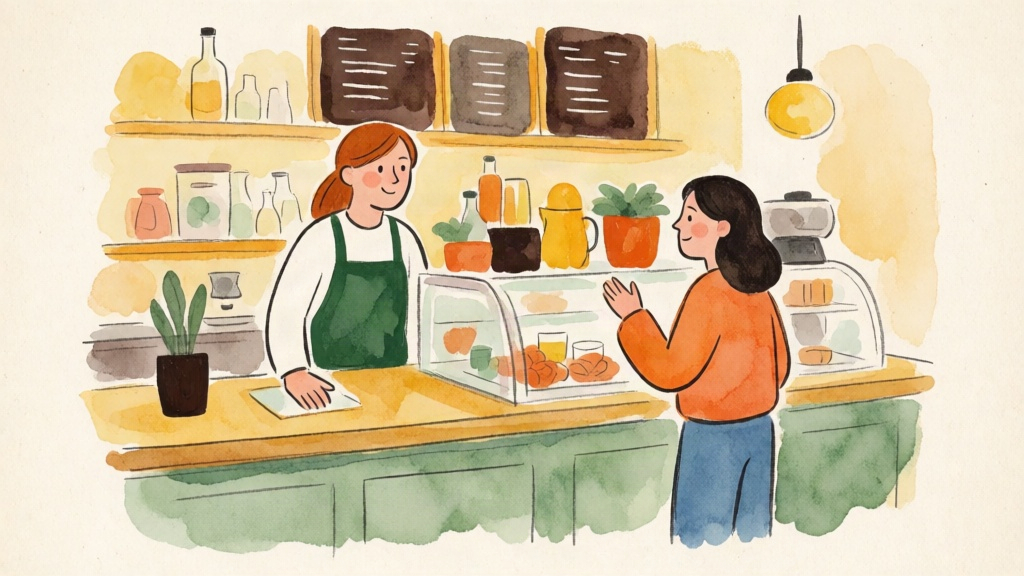
Welcome to today's French session! Imagine you are stepping inside a charming, bustling café right in the heart of Paris. The rich aroma of freshly roasted espresso fills the warm air as porcelain cups clink gently in the background. Our character, Marie, approaches the wooden counter to order her morning drink. Ordering in French can feel intimidating at first, but with just a few polite core phrases, you can order anything smoothly and naturally. Today, we are going to break down this everyday interaction piece by piece, decoding every single phrase together. By taking it slowly, step by step, you will understand exactly what each word means and how it sounds. By the end of our lesson, you will hear the complete interaction seamlessly from start to finish. Let us begin by listening closely to Marie's polite opening greeting right at the café counter.

After listening

How was “Au café”?

Tell us how comfortable this felt to calibrate your vocabulary review.

Full lesson transcript

Read the complete lesson, including the French dialogue and English explanations.

Part 1

Welcome to today's French session! Imagine you are stepping inside a charming, bustling café right in the heart of Paris. The rich aroma of freshly roasted espresso fills the warm air as porcelain cups clink gently in the background. Our character, Marie, approaches the wooden counter to order her morning drink. Ordering in French can feel intimidating at first, but with just a few polite core phrases, you can order anything smoothly and naturally. Today, we are going to break down this everyday interaction piece by piece, decoding every single phrase together. By taking it slowly, step by step, you will understand exactly what each word means and how it sounds. By the end of our lesson, you will hear the complete interaction seamlessly from start to finish. Let us begin by listening closely to Marie's polite opening greeting right at the café counter.

Part 2

Bonjour, un café, s'il vous plaît.

Bonjour, un café, s'il vous plaît.

Part 3

Marie begins by saying: 'Hello, a coffee, please.' In French culture, greeting someone with 'bonjour' before asking for anything is an essential sign of respect and warmth. After the greeting, she simply states what she wants: 'un café', which means 'a coffee'. To make the request polite, she finishes with 's'il vous plaît', the standard French phrase for 'please'. Literally, this phrase translates to 'if it pleases you'. Notice how smoothly the words connect when spoken out loud. The word 'café' ends with a crisp, upward sound, while 's'il vous plaît' glides off the tongue like one continuous musical phrase. When you enter any French café, starting with this simple structure ensures a friendly and pleasant welcome from your barista every single time. Let us listen to Marie say this greeting and order once again.

Part 4

Bonjour, un café, s'il vous plaît.

Bonjour, un café, s'il vous plaît.

Part 5

Je voudrais un grand café.

Je voudrais un grand café.

Part 6

Marie clarifies her order by saying: 'I would like a large coffee.' The key structure here is 'je voudrais', which means 'I would like'. This is the golden phrase for making polite requests in French. It sounds much softer and more courteous than simply saying 'I want'. Next comes 'un grand café'. The word 'grand' means 'large' or 'big', and notice how it comes directly before the noun 'café'. In French, certain common adjectives like size often sit in front of the noun they describe. Pay close attention to the smooth, rounded sound of 'voudrais' and the silent 'd' at the end of 'grand'. You do not pronounce the final letter 'd'; it simply stops cleanly on the vowel sound. Listen carefully as Marie expresses her polite request once more.

Part 7

Je voudrais un grand café.

Je voudrais un grand café.

Part 8

Avec du lait, s'il vous plaît.

Avec du lait, s'il vous plaît.

Part 9

Now, Marie specifies how she takes her drink: 'With milk, please.' The word 'avec' means 'with'. Following that, we hear 'du lait', which translates to 'milk' or 'some milk'. In French, when referring to an unspecified quantity of a drink or food, you use little connector words like 'du'. The word 'lait' ends with a silent 't', so you only pronounce the soft vowel sound at the end. Marie finishes her sentence once again with the polite marker 's'il vous plaît'. Adding this touch of politeness keeps the tone gracious and friendly. Listen to how the crisp consonant of 'avec' blends naturally into 'du lait', creating a steady, rhythmic cadence. Let us hear Marie speak this sentence one more time so your ears can absorb the flow perfectly.

Part 10

Avec du lait, s'il vous plaît.

Avec du lait, s'il vous plaît.

Part 11

Merci, merci beaucoup, au revoir.

Merci, merci beaucoup, au revoir.

Part 12

To close the interaction warmly, Marie says: 'Thank you, thank you very much, goodbye.' You probably recognize 'merci', the universal French word for 'thank you'. To express extra gratitude, she adds 'merci beaucoup', which means 'thank you very much' or 'thanks a lot'. Notice that in 'beaucoup', the final letter 'p' is completely silent, leaving a round, soft ending. Finally, she says 'au revoir', the classic French farewell meaning 'goodbye' or literally 'until we see each other again'. Combining gratitude with a polite farewell is the hallmark of everyday courtesy across France. Listen to the bright, cheerful rhythm of these closing words as Marie receives her coffee with a warm smile. Let us hear this friendly sign-off one more time.

Part 13

Merci, merci beaucoup, au revoir.

Merci, merci beaucoup, au revoir.

Part 14

Bonjour, un café, s'il vous plaît.

Je voudrais un grand café.

Avec du lait, s'il vous plaît.

Merci, merci beaucoup, au revoir.

Bonjour, un café, s'il vous plaît.

Je voudrais un grand café.

Avec du lait, s'il vous plaît.

Merci, merci beaucoup, au revoir.

Part 15

Fantastic work! You just decoded and understood an entire authentic Parisian café interaction from start to finish. Take a moment to celebrate this achievement. You learned how to open any interaction with a respectful 'bonjour', how to use the versatile polite request 'je voudrais' to ask for 'un grand café', and how to specify additions with 'avec du lait'. You also mastered polite bookends with 's'il vous plaît', 'merci beaucoup', and 'au revoir'. These foundational building blocks are real French phrases that you can use immediately whenever you step up to a counter in any French-speaking city. With just these few core expressions in your linguistic toolkit, you are already communicating clearly, courteously, and confidently. Keep practicing these melodies aloud, trust your ears, and enjoy the feeling of speaking real French. Thank you so much for learning with us today, and until next time, keep listening, keep repeating, and enjoy every single step of your language journey!

Get personalized lessons in French

In Fabling, each podcast is uniquely generated from the vocabulary and grammar rules you’re currently practicing.

Try a free story

Your first personalized story is free. No card needed.