Podcast lesson · A2

Un día en el mercado

A Day at the Market

Un día en el mercado
0:007:46

Chapters

Introduction

Welcome back to the Spanish story podcast! Today, we follow our friend Carlos as he spends a sunny morning at a lively outdoor market. Carlos has no work today, plenty of free time, and an empty bag ready to fill with fresh food and special gifts. Along the way, we will focus on direct object pronouns: lo, la, los, and las. These tiny words are essential tools in Spanish because they allow you to refer back to things you have already mentioned without repeating the same noun again and again. You will hear them placed directly before conjugated verbs, or attached neatly onto the end of infinitive verbs. Pay special attention to how Carlos talks about fruit, like a sweet melon, and beautiful traditional handicrafts. Listen closely for the vocabulary words puesto, which means a market stall, and artesanía, meaning handicraft. Relax, enjoy the colorful sights and sounds, and let us dive straight into the market with Carlos.

After listening

How was “Un día en el mercado”?

Tell us how comfortable this felt to calibrate your vocabulary review.

Full lesson transcript

Read the complete lesson, including the Spanish dialogue and English explanations.

Part 1

Welcome back to the Spanish story podcast! Today, we follow our friend Carlos as he spends a sunny morning at a lively outdoor market. Carlos has no work today, plenty of free time, and an empty bag ready to fill with fresh food and special gifts. Along the way, we will focus on direct object pronouns: lo, la, los, and las. These tiny words are essential tools in Spanish because they allow you to refer back to things you have already mentioned without repeating the same noun again and again. You will hear them placed directly before conjugated verbs, or attached neatly onto the end of infinitive verbs. Pay special attention to how Carlos talks about fruit, like a sweet melon, and beautiful traditional handicrafts. Listen closely for the vocabulary words puesto, which means a market stall, and artesanía, meaning handicraft. Relax, enjoy the colorful sights and sounds, and let us dive straight into the market with Carlos.

Part 2

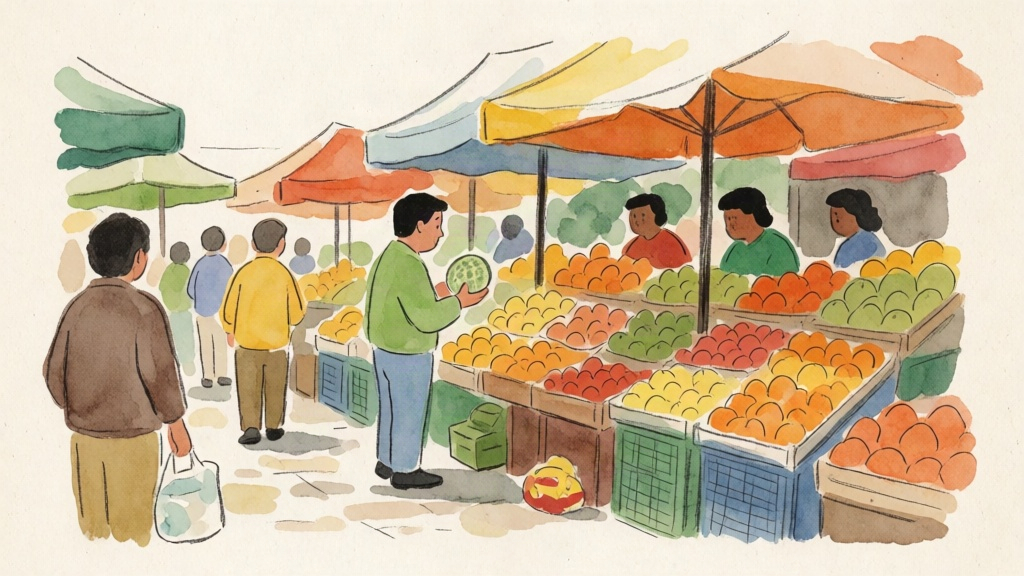
Carlos camina hacia el mercado grande con mucho tiempo libre. Ayer tuvo mucho trabajo en la oficina, pero hoy descansa. El mercado tiene muchas personas y colores brillantes. Carlos busca comida fresca para su casa. Él mira un puesto hermoso con mucha fruta deliciosa. En el puesto hay manzanas rojas y melones verdes. Carlos saluda a la vendedora amablemente. La vendedora ofrece una fruta dulce. Ella corta un pedazo de melón fresco. El melón se ve perfecto y muy maduro. Carlos lo prueba con una sonrisa. La fruta es increíblemente dulce. Carlos decide comprarla sin dudar. Carlos también mira unas manzanas brillantes. Las manzanas son rojas y frescas. Carlos decidió comprarlas para comer mañana. La vendedora coloca toda la fruta en una mesa pequeña. Carlos observa el puesto con calma y alegría. Él tiene tiempo para caminar más. El mercado tiene muchas cosas interesantes hoy. Carlos quiere visitar otro puesto antes de volver a casa. Él sigue su camino tranquilamente entre la gente alegre.

Part 3

Carlos llega a otro sector del mercado popular. Aquí no hay comida, sino una tienda con artesanía tradicional. El puesto tiene objetos de madera, tela y barro. Carlos admira cada artesanía con atención y curiosidad. Su hermana cumple años mañana y él necesita un regalo bonito. Carlos ve una figura pequeña de madera en la mesa. La pieza es única y muy especial. Carlos la mira con cuidado durante varios minutos. El vendedor explica el trabajo manual detrás de cada pieza. Carlos quiere llevar la pieza de madera como regalo. Carlos decidió comprarla para su hermana querida. Además, el vendedor muestra unos adornos de tela colorida. Los adornos son típicos y muy llamativos. Carlos los examina atentamente en sus manos. Son objetos perfectos para decorar la sala de la casa. Carlos decide comprarlos también. El vendedor envuelve la artesanía con papel suave para proteger todo. Carlos sonríe porque encontró regalos maravillosos en este puesto. Todo está listo para el momento final de las compras.

Part 4

Carlos tiene toda la fruta y la hermosa artesanía listas en las mesas. Ahora llega el momento de pagar todo lo que eligió. Carlos saca su dinero del bolsillo para pagar la cuenta completa. El vendedor recibe el dinero y le agradece con amabilidad. Carlos toma la fruta fresca del primer puesto. La fruta es pesada, pero Carlos la guarda con cuidado en su bolsa grande. Luego, toma las figuras de artesanía envueltas en papel. Carlos las coloca con mucha suavidad dentro de la misma bolsa. Todo entra perfectamente en la bolsa resistente. Carlos mira su reloj y ve que todavía tiene tiempo libre. Ayer pensó que no tendría un buen día, pero hoy fue fantástico. Mañana podrá disfrutar de la fruta dulce y entregar el regalo especial a su hermana. Carlos sale del mercado con una sonrisa enorme. Él camina de regreso a casa con el corazón contento y su bolsa llena de cosas buenas. El mercado siempre tiene sorpresas maravillosas para todos los visitantes.
Part 5

Welcome back! Carlos had a very productive day at the market, and throughout his shopping trip, we heard several clear examples of direct object pronouns in action. Remember, in Spanish, direct object pronouns replace direct objects so you do not have to repeat the noun. We use lo for masculine singular nouns, la for feminine singular nouns, los for masculine plural nouns, and las for feminine plural nouns. Let us look at three exact moments from the story to see how naturally this works. When Carlos tested the sweet melon, we heard: El melón: Carlos lo probó. Here, lo replaces el melón, sitting right before the conjugated verb probó. Later, when Carlos looked at the fresh apples, we heard: Las manzanas: Carlos decidió comprarlas. Notice how las replaces las manzanas and attaches directly to the end of the infinitive verb comprar, forming the single word comprarlas. And in the second part, when Carlos looked at the wooden figure, we heard: La pieza es única y muy especial. Carlos la mira con cuidado. In that line, la replaces la pieza and appears right before the conjugated verb mira. Here is an actionable tip you can use today: whenever you are practicing Spanish and you find yourself repeating the same noun twice in back-to-back sentences, pause and swap the second noun for lo, la, los, or las. If you are using a conjugated verb, pop the pronoun right before it, like lo compro or la tengo. If you have an infinitive verb after another verb, you can simply attach the pronoun straight to the end, like quiero comprarlo or voy a verla. This simple habit will make your spoken Spanish sound much smoother, more natural, and wonderfully fluent. Thank you so much for listening and practicing with us today. Keep exploring, keep speaking, and see you next time!

Get personalized lessons in Spanish

In Fabling, each podcast is uniquely generated from the vocabulary and grammar rules you’re currently practicing.

Try a free story

Your first personalized story is free. No card needed.