Podcast lesson · A0

Un café con leche

A Coffee with Milk
Un café con leche
0:006:57

Chapters

The Setup

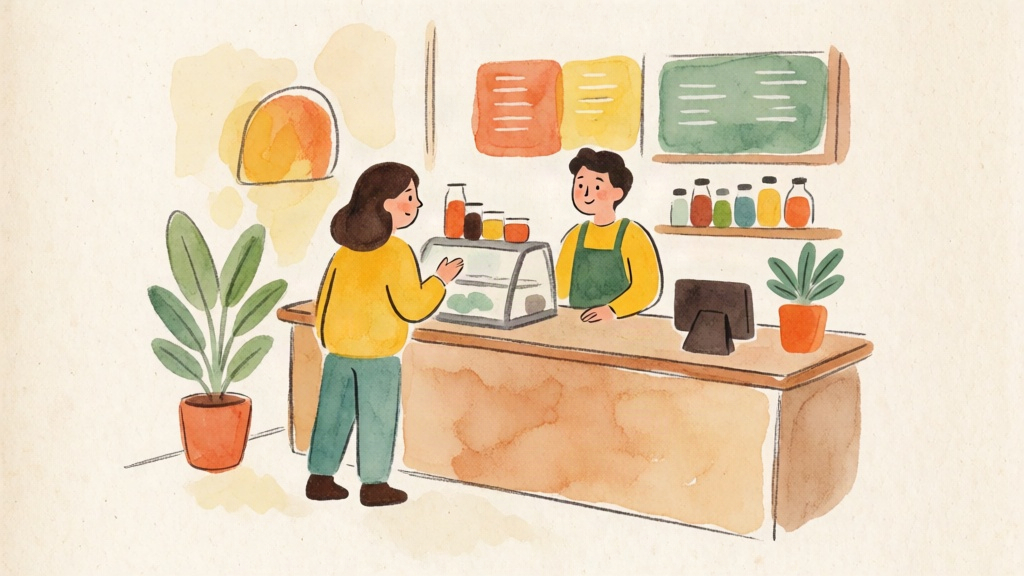
Welcome! Imagine you are stepping into a cozy neighborhood café in the morning. The aroma of freshly ground coffee beans fills the air, and there is a friendly barista standing behind the counter, ready to take your order. Our character today, Ana, walks right up to the counter to get her morning drink. She greets the barista, clearly asks for a large coffee, chooses to have it with milk, and wraps up the interaction with polite gratitude. Ordering food and drinks is one of the most empowering things you can learn in a new language, and today, you will master every single syllable needed to do this with total ease. We are going to decode this entire real-world conversation step by step, breaking down each phrase into simple, memorable pieces so your ear catches every sound effortlessly. Let us jump right in and listen closely to Ana's very first greeting.

After listening

How was “Un café con leche”?

Tell us how comfortable this felt to calibrate your vocabulary review.

Full lesson transcript

Read the complete lesson, including the Spanish dialogue and English explanations.

Part 1

Welcome! Imagine you are stepping into a cozy neighborhood café in the morning. The aroma of freshly ground coffee beans fills the air, and there is a friendly barista standing behind the counter, ready to take your order. Our character today, Ana, walks right up to the counter to get her morning drink. She greets the barista, clearly asks for a large coffee, chooses to have it with milk, and wraps up the interaction with polite gratitude. Ordering food and drinks is one of the most empowering things you can learn in a new language, and today, you will master every single syllable needed to do this with total ease. We are going to decode this entire real-world conversation step by step, breaking down each phrase into simple, memorable pieces so your ear catches every sound effortlessly. Let us jump right in and listen closely to Ana's very first greeting.

Part 2

Hola, un café, por favor. Hola, un café, por favor.

Part 3

Ana says, hello, a coffee, please. She begins with that essential greeting, hola, which simply means hello. Notice how the letter h is completely silent in Spanish, so it sounds just like oh-la. Then she uses the phrase un café, which means a coffee. Here, un is the word for a or one before a masculine noun like café. To make her request polite and natural, she attaches por favor at the end, which is the universal Spanish phrase for please. Putting it all together, hola, un café, por favor gives you an immediate, courteous way to start any order at a café counter. Listen carefully to how smoothly the words flow together, paying special attention to that soft silent h and the crisp, clear rhythm of por favor as we hear it once again right now.

Part 4

Hola, un café, por favor. Hola, un café, por favor.

Part 5

Yo quiero un café grande. Yo quiero un café grande.

Part 6

That translates to, I want a large coffee. The key word to focus on here is quiero, which means I want. When you combine it with the pronoun yo, you get yo quiero, meaning I want. This is an incredibly versatile powerhouse phrase that you can use whenever you need to express a desire or order something specific. Notice also the word grande, which means large or big. In Spanish, descriptive words like grande usually follow the noun they describe, so we say café grande rather than grande café. Listen to the distinct pattern: yo quiero sets up the desire, followed by the specific item, un café grande. Pay attention to how direct yet natural this sounds as your brain connects the meaning to the sound. Let us listen to it spoken smoothly one more time.

Part 7

Yo quiero un café grande. Yo quiero un café grande.

Part 8

Con leche, por favor. Con leche, por favor. Con leche.

Part 9

Ana specifies her drink by saying, with milk, please. The little word con means with, and leche means milk. Together, con leche is the standard phrase for specifying that you want milk in your beverage. If you ever wanted black coffee without milk instead, you would simply use the word sin, saying sin leche. Ana adds por favor to keep her request polite and friendly. Notice the pronunciation of leche, with its clear, crisp ch sound in the middle and open vowel endings. Combining con leche with por favor gives you a quick, highly practical chunk of language that baristas hear all day long across the Spanish-speaking world. Keep your ears tuned to the rhythm of con leche as we repeat the exact phrase right now for you to absorb.

Part 10

Con leche, por favor. Con leche, por favor. Con leche.

Part 11

Muchas gracias, por favor. Muchas gracias, por favor. Gracias.

Part 12

Here, Ana says, thank you very much, please. The word gracias means thank you, and when you place muchas in front of it, you get muchas gracias, meaning thank you very much or many thanks. This is the warmest and most common way to show appreciation when someone serves you or hands you your order. Notice how the word muchas agrees with the plural idea of thanks. Pronouncing gracias with a smooth, soft s sound at the end feels effortless once you hear it a few times. By pairing gratitude with a friendly smile, you leave a wonderful impression every single time you interact with native speakers. Let us listen to this polite closing phrase once again so your brain cements the exact sound and its friendly rhythm.

Part 13

Muchas gracias, por favor. Muchas gracias, por favor. Gracias.

Part 14

Hola, un café, por favor. Yo quiero un café grande. Con leche, por favor. Muchas gracias, por favor. Hola, un café, por favor. Yo quiero un café grande. Con leche, por favor. Muchas gracias.

Part 15

Fantastic job! You just listened to and understood a complete, authentic interaction at a café counter entirely in Spanish. Look at what you have accomplished today: you learned how to start with a friendly greeting using hola, how to state exactly what you want using the powerful phrase yo quiero, how to customize your order with con leche or sin leche, and how to express genuine appreciation with muchas gracias and por favor. These building blocks are your foundation for ordering in any restaurant, café, or shop across the Spanish-speaking world. Whenever you practice, remember how simple it is to build sentences by combining what you want with polite expressions. Be proud of the progress you made today in tuning your ear and expanding your comprehension. Keep practicing, keep listening, and join us again next time for another practical step forward on your language journey. ¡Hasta pronto!

Get personalized lessons in Spanish

In Fabling, each podcast is uniquely generated from the vocabulary and grammar rules you’re currently practicing.

Try a free story

Your first personalized story is free. No card needed.